

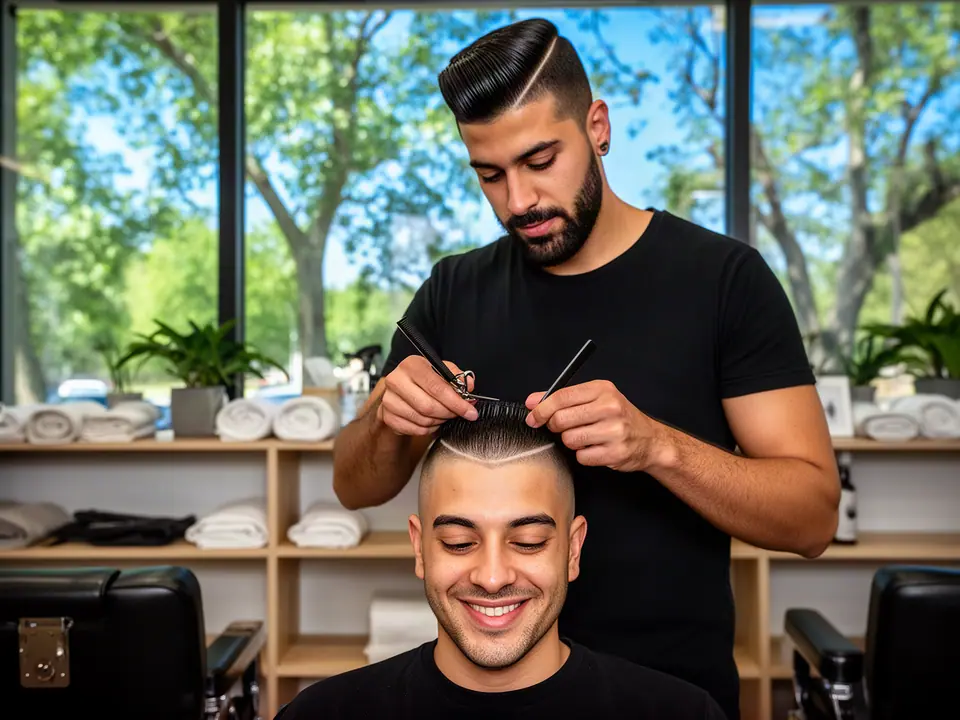
Wayne County, MI counted 354 employer establishments under beauty salons in 2023 (CBP).
Stations, mirrors and chairs are equipment; retail product can go on inventory financing; early pay for new stylists fits a credit line; and a card-heavy barbershop can look at a merchant cash advance, which costs more in the invented case here. Anything attached to the walls or plumbed in is property work outside this site.
At a glance
- Beauty salons, Wayne County, MI
354 employer establishments (CBP 2023)
- Beauty salons with fewer than 5 employees
237, or 66.9% (CBP 2023)
- Beauty salons, ZIP 48150
14 employer establishments (ZBP 2023)
- Beauty salons without paid employees, Wayne County, MI
12,233 (Nonemployer Statistics 2024)
Planning for retail product in Wayne County, MI? Salon business loans
A salon that starts selling a professional hair care line pays the distributor for the first order before a bottle leaves the shelf. Illustration only, invented figures: a Wayne County, MI salon places a $6,480 first order of shampoos, conditioners and styling products for a new retail line.
Carried on inventory financing at a 13.2% annual rate, the invented order turns into five monthly installments of $1,339.08; the salon hands over $6,695.40 for $6,480 of product, a $215.40 interest charge. The schedule is short because retail product is meant to sell within months; a line that takes longer to sell than planned still has to be paid on the agreement's dates.
A freestanding display case for the product is equipment and can ride with the order or go on its own agreement. Shelving screwed into a wall is work on the space, outside this site.
Freestanding styling stations and floor mirrors for Livonia, MI salon owners
Illustration only, invented figures: a Livonia, MI salon replaces four worn stations with freestanding styling stations at $1,915 each and four floor mirrors at $640 each, $10,220 for the set.
Through equipment financing at a 12.05% annual rate for 36 months, the invented set runs $339.69 a month; the 36 payments come to $12,228.84, including $2,008.84 of interest. Freestanding pieces can move with the salon if it changes suites, which is one reason a partner may treat them as equipment.
Stations and mirrors bolted to the wall, and any outlet or lighting work behind them, are changes to the building. Those stay outside the request, so the quote should list only the movable pieces. A day spa's treatment beds, wax warmers and sauna cabinet have an article of their own.
- the vendor quote, with the station and mirror models
- recent business bank statements, including card deposits
- the salon's time in business and its lease end date
- any payments already running on other salon equipment
Beauty salons, barber shops and nail salons in Wayne County, MI: three Census codes
County Business Patterns splits personal care shops into separate codes, and in Wayne County, MI the beauty salon code is far larger than the other two. Very small shops dominate all three.
| Census code | Employer establishments | Fewer than 5 employees | Share under 5 |
|---|---|---|---|
| Beauty salons (NAICS 812112) | 354 | 237 | 66.9% |
| Barber shops (NAICS 812111) | 59 | 51 | 86.4% |
| Nail salons (NAICS 812113) | 60 | 46 | 76.7% |
Within ZIP 48150, ZIP Code Business Patterns found 14 beauty salons in 2023, counted by physical address.
Chair renters and solo stylists without paid staff are counted in a different program. Nonemployer Statistics for 2024 list 12,233 beauty salons in Wayne County, MI with no paid employees, along with 2,220 nonemployer establishments under barber shops (NAICS 812111) and 2,507 under nail salons (NAICS 812113). Those owner-only shops in Livonia, MI and around the county can ask about funding too; the industries overview sets the county counts for other trades side by side.
Credit line uses for Wayne County, MI salon owners: a second chair row and new stylists' first paydays
Adding a second row of chairs means paying for the chairs and, often, paying the new stylists a base wage before their own clients fill the book. Illustration only, invented figures: a Wayne County, MI salon buys four hydraulic styling chairs at $780 each, $3,120, and puts them on a 24-month equipment agreement at a 12.4% annual rate: $147.45 a month, $3,538.80 over the term.
The same invented salon pays two new stylists a combined base of $2,150 every other week. Over the first eight weeks of this invented case that is four paydays, and it draws $2,150 on its line of credit each payday. If it clears all four draws on day 70, simple interest at a 14.75% annual rate comes to $170.29 for this invented case.
Splitting it this way keeps the chairs on a schedule that matches their working life and leaves the line for short gaps. The amounts, rates and terms are invented; a partner sets the real ones.
A Livonia, MI barbershop and a merchant cash advance: the collected total worked out
Illustration only, invented figures: a Livonia, MI barbershop wants $4,715 for new clippers and trimmers, a UV sterilizer cabinet and a second card terminal, and most of its sales arrive by card.
A merchant cash advance priced at a 1.32 factor means the funding source collects $6,223.80 in all, so the invented advance costs $1,508.80. With a 12% holdback on invented card sales of $640 a day, $76.80 is collected each card day, and the advance is finished after 82 card days.
A merchant cash advance is not a loan; it is a sale of future card receipts, and a week with fewer haircuts collects less. For small equipment like this, equipment financing or a short working capital loan can cost less, and the barber can ask for both to compare.
By Lakebridge Finance · Updated